Closet Shelves and Rods: Understanding Your Storage Options
A plain-words overview of closet hardware: fixed shelves and rods, adjustable systems, freestanding towers, tension rods, hanging fabric shelves and add-on rods, with how to choose and what to measure.
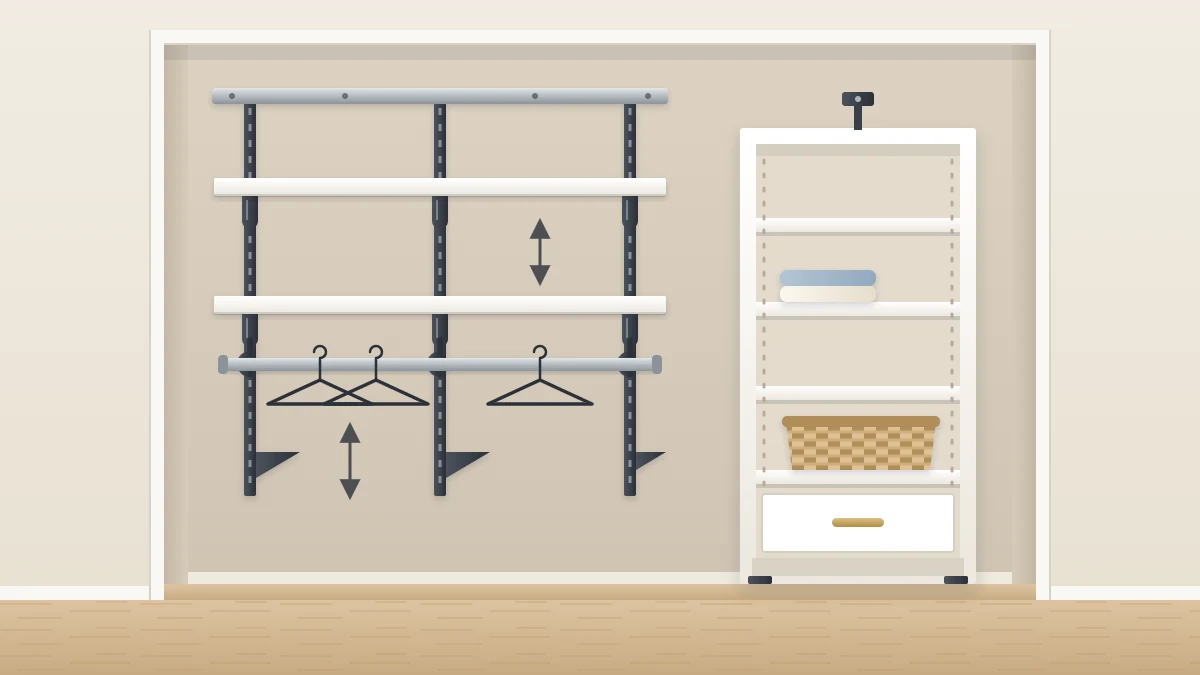
Before you buy anything to change a closet, it helps to know what the choices are called and how each one is held up. Closet shelves and rods come in a handful of basic types, and the differences between them matter more than the differences between products of the same type.
This overview explains each type in plain words, compares them in a table, and sets out the planning points that apply to all of them. It does not tell you how to fix anything to a wall; that information belongs to the maker of the product you choose.
The six basic types
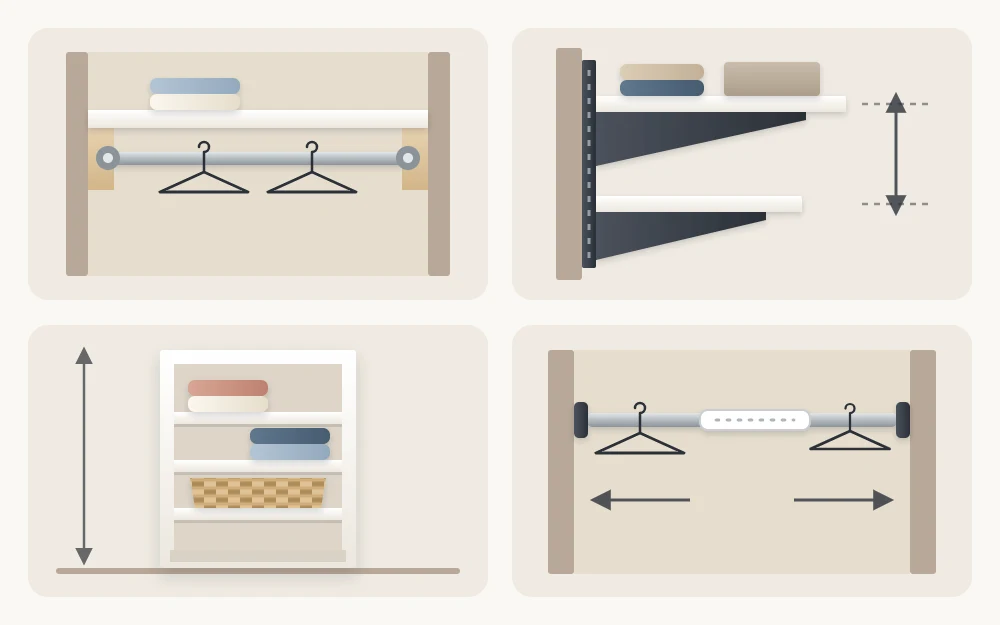
- Fixed shelf and rod. The arrangement most closets start with: one shelf and one rod fixed to the walls at a set height. Simple and out of the way, but it cannot be moved without refitting.
- Adjustable systems. Vertical slotted strips fixed to the wall, or hung from a horizontal top rail, with brackets that hook in at any height. Shelves and rods rest on the brackets and can be moved as your needs change. These are often sold as track systems.
- Freestanding closet units and towers. Furniture-like frames of shelves, drawers and sometimes rods that stand on the floor. They need no fixing to carry their contents, though tall ones need anchoring against tipping.
- Tension rods and tension shelves. Rods or shelves that extend and press between two facing walls, held by pressure alone.
- Hanging fabric shelves. A soft column of compartments that hangs from the rod.
- Add-on lower rods. A second rod that hangs from the upper one to create double-hang, meaning two levels of short garments in the same width.
The types compared
| Type | Needs wall fixing? | Adjustable? | Suits |
|---|---|---|---|
| Fixed shelf and rod | Yes | No | Needs that will not change |
| Adjustable system | Yes | Yes, by moving brackets | Owners whose storage changes over time |
| Freestanding unit or tower | Only anti-tip anchoring | Often, by shelf position | Renters; adding folded storage |
| Tension rod or shelf | No | Yes, by repositioning | Temporary setups between two facing walls |
| Hanging fabric shelf | No; hangs from the rod | No | Folded items where there is spare rod width |
| Add-on lower rod | No; hangs from the rod | Sometimes, in height | Short garments under an existing rod |
How to choose between them
Four questions narrow the list quickly.
Do you rent or own? If you rent, check what your lease allows before fixing anything to a wall. Freestanding units and items that hang from the existing rod leave the walls untouched and move with you.
What are the walls made of? Anything wall-fixed depends on the wall behind it, and walls differ from home to home and sometimes within one closet. If you do not know what yours are, find out before choosing a wall-fixed type.
How often do your needs change? A child’s closet, a shared closet or a home you have just moved into will probably be rearranged. Adjustable and freestanding types allow that; fixed ones do not.
What do you store? Count your hanging garments by length and your folded items by stack. Mostly hanging clothes call for rod length; mostly folded clothes call for shelves or drawers.
Planning points for any type
Whichever type you choose, three measurements decide whether it works. The guide on how to measure a closet shows how to record the space itself; the points below are about matching the hardware to what goes on it.
Shelf depth
Match shelf depth to your folded clothes. Fold a sweater and a pair of jeans the way you normally do and measure them front to back. Closet shelves are often around 12 to 16 in (30 to 40 cm) deep, but treat that as a starting point and measure your own stacks. A shelf much deeper than the stack creates a hidden back row; the guide on how to organize a deep closet deals with that problem.
Vertical spacing
Space shelves for what will sit on them. Measure the height of a stack you can lift out comfortably, or the height of your bins, and add enough clearance for your hand. Too much space above a stack invites a taller, less stable pile. The guide on how to organize folded clothes explains how high to stack different garments.
Rod height
Set each rod for the longest garment in that section. Hang that garment on its hanger, measure from the top of the hanger hook to the hem, and add clearance below. Do this separately for long garments and short ones. A single rod is commonly placed somewhere around 66 in (168 cm) from the floor, but your garments and your reach matter more than a common figure.
What carries the weight
Good to know
How much a shelf, rod, bracket or anchor can carry depends on the product, the fixing hardware and the wall it is fixed to. This site gives no load figures. Use the hardware and the method in the manufacturer’s installation instructions, respect the stated load limits, and ask the manufacturer or a qualified installer when unsure.
The same applies to types that need no wall fixing. A tension rod relies on the pressure between two walls and has a stated limit of its own. A hanging fabric shelf and an add-on lower rod pass everything they hold to the rod above, so the limits stated for both the add-on and the existing rod apply. Read the product instructions before loading any of them.
Freestanding units and tipping
A freestanding tower carries its contents on its own frame, which is why it suits rented homes. A tall unit can still tip forward, particularly when drawers are pulled open or someone climbs on it.
Anchor tall freestanding units against tipping with the anti-tip hardware and method in the manufacturer’s instructions. For general background, see the U.S. Consumer Product Safety Commission’s Anchor It campaign.
Start from your count
Hardware is the last decision, not the first. Count what you own, decide what hangs and what folds, measure the closet, and only then choose a type. A closet planned in that order usually needs less hardware than expected, and it is easier to change later.
Frequently asked questions
Which closet system is best for renters?
Types that leave the walls alone are the usual choice: freestanding units and towers, hanging fabric shelves and add-on lower rods. Check your lease before fixing anything to a wall. Tall freestanding units should still be anchored against tipping as the manufacturer instructs, so ask your landlord about that.
How high should a closet rod be?
High enough for the longest garment in that section to hang clear, and low enough for you to reach. Measure that garment on its hanger from the top of the hook to the hem and add clearance. Common figures are only a starting point; your garments and reach decide.
How much can a closet shelf or rod carry?
There is no general answer. It depends on the product, the fixing hardware and the wall it is fixed to. Look for the load limit stated in the manufacturer's instructions or specifications, stay within it, and ask the manufacturer or a qualified installer when unsure.