How to Organize Folded Clothes on Closet Shelves
Why shelf stacks turn into heaps and how to prevent it: one fold width per category, low stacks with the folded edge facing out, shelf dividers, bins for soft items and a plan for deep shelves.
Shelf stacks start out neat and end up as heaps. You pull one sweater from the middle, the stack leans, the next one slides, and within a couple of weeks the shelf is a pile you dig through.
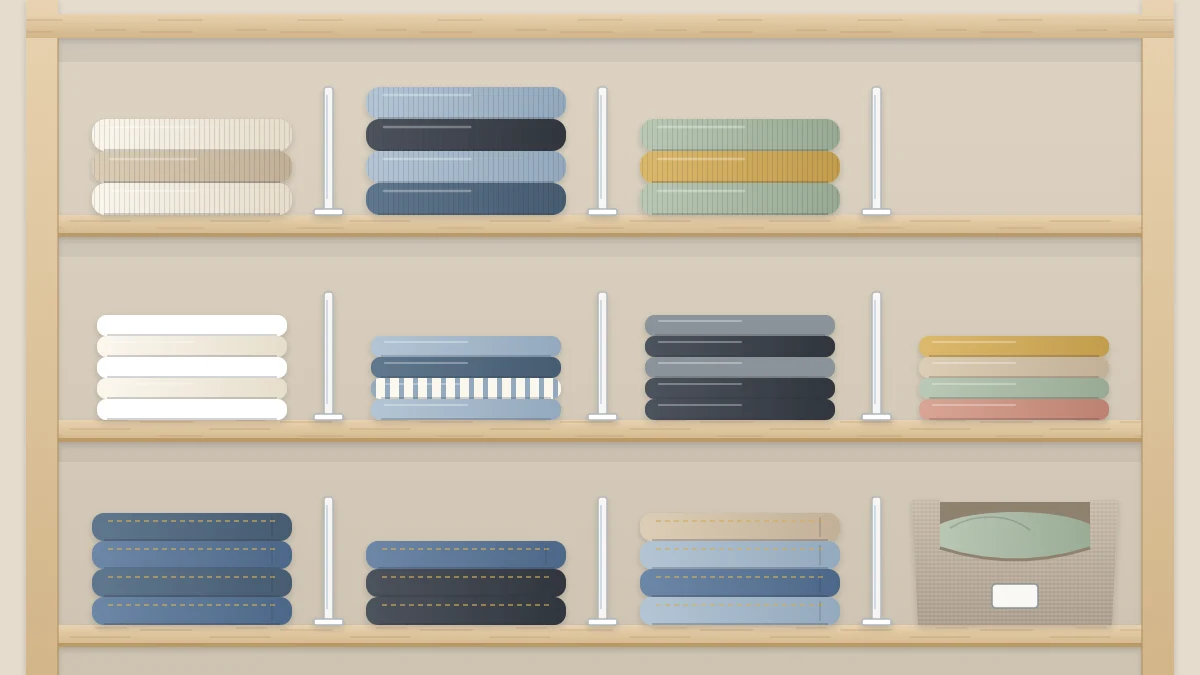
The fix is not more careful folding. To organize folded clothes so they stay organized, you need stacks that are built to be used: the same width, low, one category each, with the folded edge facing you. This guide explains why stacks fail and how to set shelves up so they do not.
Why stacks collapse
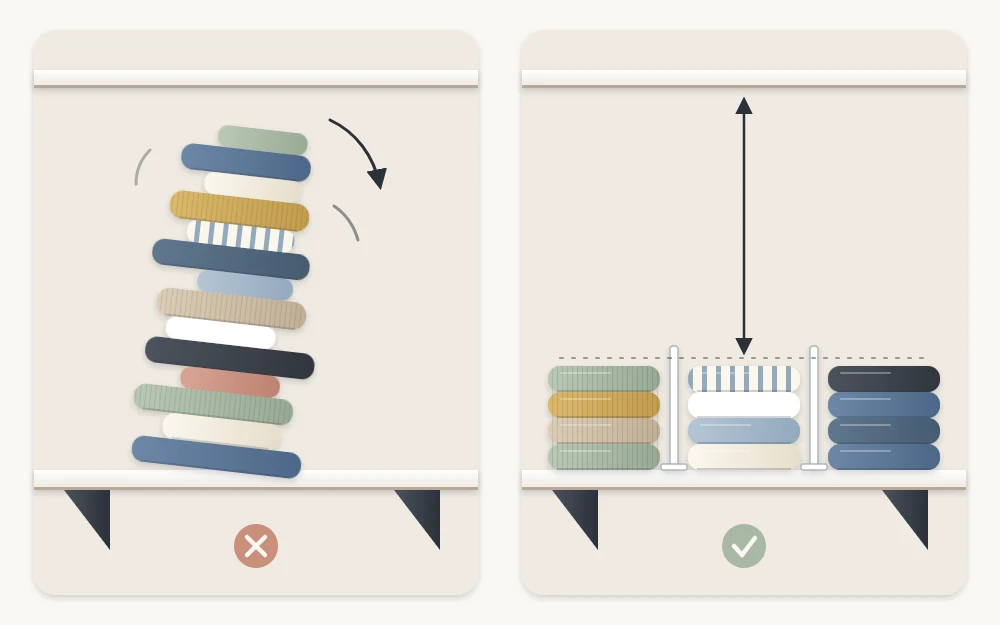
Three causes account for nearly every fallen stack:
- Too tall. The higher the stack, the more it sways, and the more items sit on top of the one you want.
- Mixed in size. Wide items on narrow ones, or thick on thin, make an uneven column that slides apart.
- Pulled from the bottom. Tugging out a low item drags its neighbors with it.
Fold each category to one width
A stack is stable when every item in it has the same footprint. Start by measuring the shelf depth, front to back, and the width you can give each stack. Shelves are often around 12 to 16 in (30 to 40 cm) deep, but measure your own, because the fold has to suit the shelf you have.
Then choose one folded size per category. All T-shirts fold to the same rectangle, all sweaters to another. The folded item should sit fully on the shelf without hanging over the front edge.
A simple template fold
Cut a piece of stiff cardboard to the width you want the finished fold to be, or use a folding board. Lay the garment face down, place the template on the center of the back, and fold each side in over it, sleeves included. Fold the bottom up to the top once or twice, depending on the shelf depth, then slide the template out. Every item folded around the same template comes out the same width.
Build stacks that are easy to use
Keep them low
A good test is whether you can lift the top few items with one hand and take out the one you want with the other, without the stack shifting. For thick sweaters that may be three or four items; for thin T-shirts it can be more. If a stack fails the test, split it in two.
Folded edge facing out
Turn every item so the smooth, rounded fold faces the front of the shelf and the loose edges face the back. Each garment then shows as one clean line. You can count what is there, tell the items apart, and take hold of exactly one.
One category per stack
Do not top up a short stack of sweaters with a few T-shirts to use the space. Mixed stacks are uneven, and they hide what is in them. If a category makes only a small stack, let it be a small stack.
Stop stacks leaning into each other
Stacks standing side by side tend to merge, especially soft ones. Shelf dividers, the upright panels that slip onto or stand on a shelf, give each stack walls to rest against and mark where one category ends.
Some clothes will not stack whatever you do. Exercise wear, sleepwear and other soft or slippery items slump as soon as you let go. Soft items that will not stack go in an open-front bin or basket on the shelf, where they can be loosely folded and still pulled out one at a time. The guide to closet storage bins covers which kinds suit which job.
Decide which shelf holds what
Two principles settle most of the layout:
- Bulky and heavy low, light high. Jeans and thick sweaters are easier to lift from waist or chest height than from above your head, and lighter stacks are easier to manage on higher shelves.
- Most used at the easiest height. The categories you reach for daily go between shoulder and knee height. Occasional ones go above or below.
Where the two pull in different directions, let frequency win for everyday items and bulk decide the rest. For any shelf above your comfortable reach, use a stable step stool as its instructions describe, never a chair.
If you are still unsure whether a category should be on a shelf at all, the guide on what to hang and what to fold goes through the decision.
File folding as an alternative
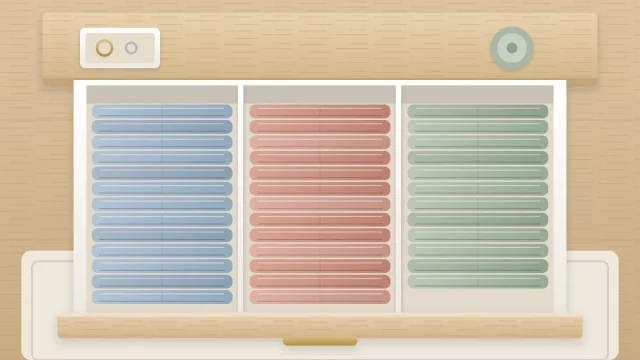
File folding means folding items into compact rectangles and standing them on edge in a row, like files in a box, instead of laying them on top of one another. Nothing sits on anything else, so you see every item at once and taking one out disturbs nothing.
On an open shelf, filed items need something to hold the row upright, so use a bin or a shallow box as the container. It suits T-shirts, exercise clothes and other thin items particularly well. The same technique is the standard approach inside drawers, and the guide on organizing clothes in drawers explains it step by step.
Deep shelves and spare room
A deep shelf tempts you to put a second row of stacks behind the first. For clothes in current use this fails quickly: the back row is invisible, and getting to it means moving the front row every time.
Two approaches work better:
- Use the back row only for off-season items. Things you will not need for months can sit behind without causing daily trouble. Swap the rows when the season changes.
- Use a pull-out bin. A bin as deep as the shelf brings the whole depth forward in one movement, so nothing is stranded at the back.
Tip
Leave a little spare room on every shelf, about a hand’s width beside the stacks and some clear space above them. A shelf filled edge to edge has no place for the clean laundry coming back, and forcing it in is how stacks get crushed.
If a category cannot fit on its shelf with that spare room, the category has outgrown the space. Reduce it or give it a second stack elsewhere before the shelf turns back into a heap.
Frequently asked questions
How high should a stack of folded clothes be?
Low enough that you can lift the top items with one hand and take out the one you want with the other. For thick sweaters that is often three or four items, and for thin T-shirts it can be more. If the stack shifts when you do this, split it into two.
How do I stop folded clothes from falling over on a shelf?
Fold every item in a category to the same width, keep each stack to one category, and keep stacks low. Add shelf dividers between stacks so they cannot lean into each other. Soft items that slump regardless, such as exercise wear, are better in an open-front bin.
Is file folding better than stacking on shelves?
It depends on the item and the space. File folding stands items on edge so you see all of them at once, which suits thin items such as T-shirts, but on an open shelf it needs a bin to hold the row upright. Thick sweaters are usually simpler to stack.