Choosing Closet Hangers: Types and What Each Is For
What a hanger actually does for a garment, the common hanger types with what each suits and what to watch for, how to match hanger width to your clothes, and how to switch to a matching set gradually.
Most closets hold a mix of wire hangers from the dry cleaner, plastic ones that came with a purchase and a few wooden ones of unknown origin. It is fair to wonder whether closet hangers matter at all.
They do, in two practical ways: a hanger affects the shape of the garment on it, and the set of hangers affects how the whole rod works. Neither requires an expensive set. It requires knowing what each type is for.
What a hanger does for a garment
A hanger has two jobs. It supports the garment at the shoulders, or at the waistband for pants and skirts, so the fabric hangs the way it was cut. And it holds the garment clear of its neighbors so air can move around it and it does not get crushed.
A hanger that does the first job badly leaves marks: bumps at the shoulders, a stretched neckline, a crease across the knee of a pair of pants. A hanger that does the second job badly makes the rod hard to use. Most choices between hanger types come down to which of these matters more for a given garment.
Hanger types at a glance
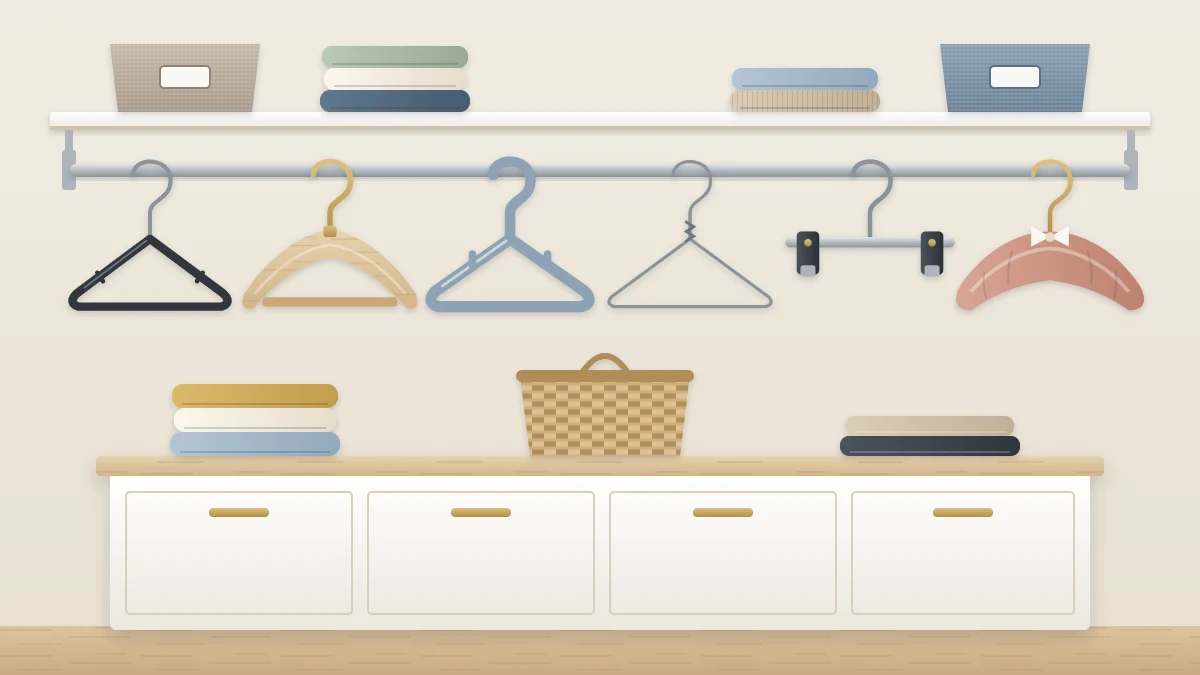
| Type | Good for | Watch out for |
|---|---|---|
| Slim flocked or non-slip | Shirts, blouses, light dresses, slippery fabrics, wide necklines | Thin shoulders give little support to structured jackets; the grip makes garments slower to pull off |
| Wooden with shaped shoulders | Jackets, coats, tailored garments | Thick, so each one takes more rod |
| Plastic tubular | Everyday shirts, T-shirts, casual items | Smooth surface lets slippery fabrics slide off; quality varies |
| Wire | Short-term use, getting clothes home | Thin and easily bent; can leave shoulder marks and creases |
| Clip hangers | Skirts, and pants hung by the hem or waistband | Clips can mark delicate fabric; check that the clips slide to fit the width |
| Bar or open-ended pants hangers | Pants folded once over the bar | A thin bar can leave a fold line; a non-slip bar helps |
| Padded | Delicate, light garments | Bulky; takes as much rod as a wooden hanger |
| Multi-tier or cascading | Several pants or skirts in one hanger’s width | Lower tiers are harder to reach; weight concentrates in one spot |
The trade-offs in plain words
Thickness versus rod space
A thick, shaped hanger supports a garment better and takes more of the rod. A slim hanger does the reverse. Use thick hangers where the garment needs them, on jackets and coats, and slim ones for everything else.
Grip versus ease of sliding
A non-slip surface keeps a silky blouse from ending up on the floor, but it also holds on when you want the garment off, and it can drag at a neckline if you pull instead of lifting. Smooth hangers release easily and lose slippery garments. Match the surface to the fabric.
Shoulder shape versus garment size
A broad, curved shoulder suits a tailored jacket and is too big for a light top in a small size. The more shaped the hanger, the more its size has to match the garment.
Match the hanger width to the garment
The ends of a hanger should sit about where the shoulder seams are. Too wide, and the ends push into the sleeves and leave bumps. Too narrow, and the shoulders slump off the ends and crease.
Adult hangers are commonly around 16 to 18 in (40 to 45 cm) wide, but garments vary a good deal, so check your own. Lay a garment flat, measure straight across from one shoulder seam to the other, and compare that with the hanger. If the clothes in one category differ a lot in size, two hanger widths in the same style will serve better than one width for everything.
Tip
To check a hanger you already own, hang the garment and look at the shoulder from the side. The fabric should follow a smooth line, with no point poking out past the seam and no fold where the hanger ends short.
Why a matching set helps
You do not need matching hangers for a closet to function, but a single type per category brings three real benefits.
- Garments hang at one height. Different hangers have different hook and shoulder heights. With one type, collars line up and you can scan along them.
- The rod looks calmer. An even line is easier on the eye, and it makes anything out of place stand out.
- It sets a natural limit. A fixed number of hangers is a fixed number of garments. When every hanger is in use, the rod is full, and something has to leave before something new goes up.
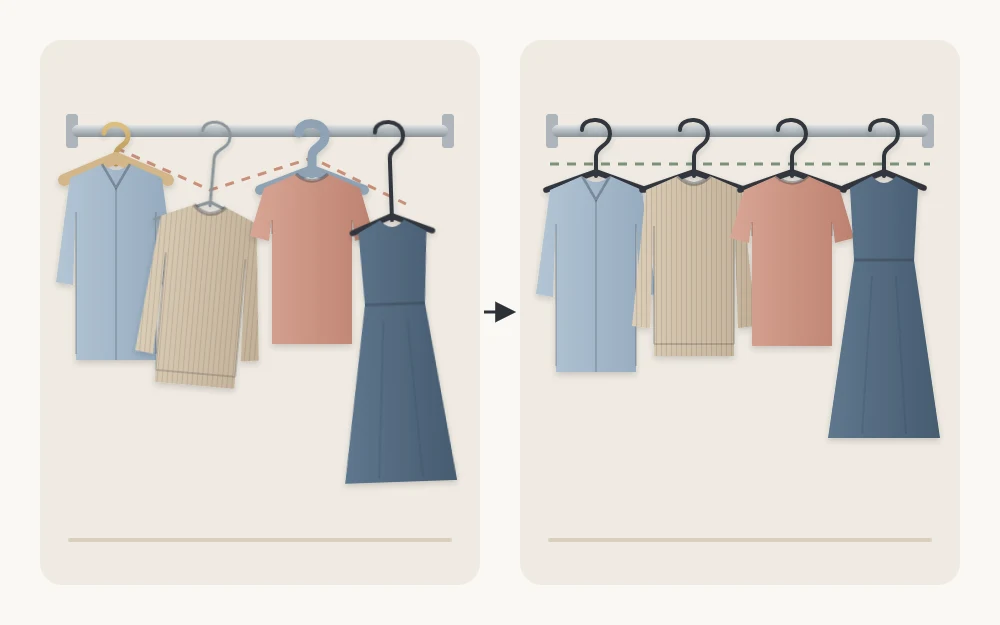
Matching hangers also slide past each other without catching, which matters when you arrange the rod. The guide on how to organize hanging clothes covers that arrangement.
Switch gradually, by category
There is no need to replace everything in one go. Count the garments in one category, such as shirts, and get that number of one hanger type. Rehang the category, see how it looks and slides, then decide about the next.
Start with the category that suffers most from its current hangers, usually jackets on wire or slippery tops on smooth plastic. Count before you buy; the count is often lower than expected once the garments that could be folded are off the rod. Keep a few of the old hangers that are in good condition for guests and pass the rest on.
Multi-tier and specialty hangers
Multi-tier or cascading hangers hold several garments one below another from a single hook. They save rod length, which is why they come up often in advice on small closet organization. They also have costs: all those garments hang from one spot on the rod, the lower tiers are awkward to reach, and taking out one item often disturbs the others. They suit things you wear in rotation, less so things you reach for daily.
They also need a clear drop beneath them, so measure the hanging height before relying on one.
Hangers with hooks or loops made for accessories work on the same principle. Whether they or a drawer are the better home is covered in the guide on how to organize belts and scarves.
Frequently asked questions
Do matching hangers really make a difference?
They are not essential, but they help. One hanger type holds every garment at the same height, slides without catching on its neighbors and makes the rod easier to scan. A fixed number of matching hangers also acts as a limit on how many garments the rod holds.
Are wire hangers bad for clothes?
Wire hangers are thin and bend easily, so over time they can leave shoulder marks and a crease across pants folded over the bar. They are fine for bringing clothes home or for short-term use. For garments that stay on the rod, a hanger with a wider shoulder gives better support.
What size hanger do I need?
The ends of the hanger should sit about at the garment's shoulder seams. Lay the garment flat, measure from one shoulder seam to the other and compare that with the hanger's width. If the ends reach into the sleeves it is too wide; if the shoulders droop off, it is too narrow.