How to Organize Belts and Scarves
Belts and scarves tangle because they are long and loose. Learn when to hang, roll or fold each one, how three scarf methods compare, and where to keep them so they go back easily.
Belts and scarves share one problem: they are long, loose and shapeless, so they slide off shelves, knot around each other and end up in a heap at the bottom of the closet. Neither fits the two things a closet does well, which are hanging garments on hangers and stacking folded ones.
The way to organize belts and scarves is to give each piece a fixed shape, either hanging straight or rolled or folded into a compact form, and then to give that shape a container or a hook of its own.
Edit before you organize
Small items pile up unnoticed. Gather every belt and every scarf from the closet, the coat hooks, bags and drawers, and lay them out in two groups. Then count each group.
Set aside anything damaged, anything that no longer fits and anything you have not reached for in a long time, and put those in the donate box or the trash as appropriate. What remains is the number you need to store, and that number decides the method: ten belts need a different answer from three.
Belts: hang them or roll them
Hanging by the buckle
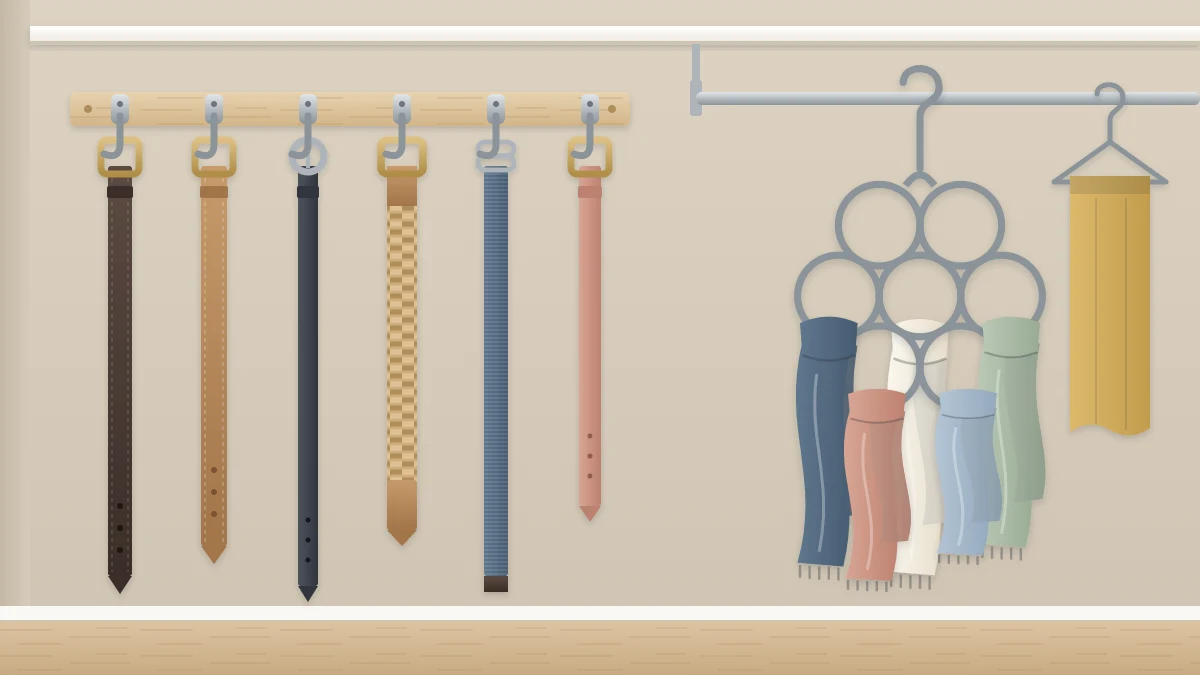
A belt hung by its buckle falls straight, stays visible and comes off with one hand. A row of hooks on the closet side wall or the inside of the door works well, with one or two belts per hook. A belt hanger, which is a hanger with a row of small hooks or a ring that hangs from the rod, does the same job without using any wall.
Hanging uses height, so check that the longest belt hangs clear of the floor and of anything stored below.
Rolling
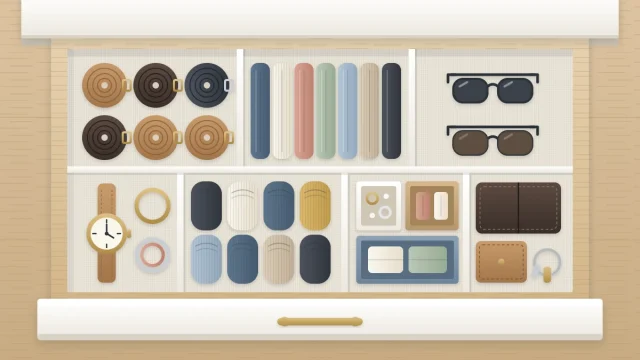
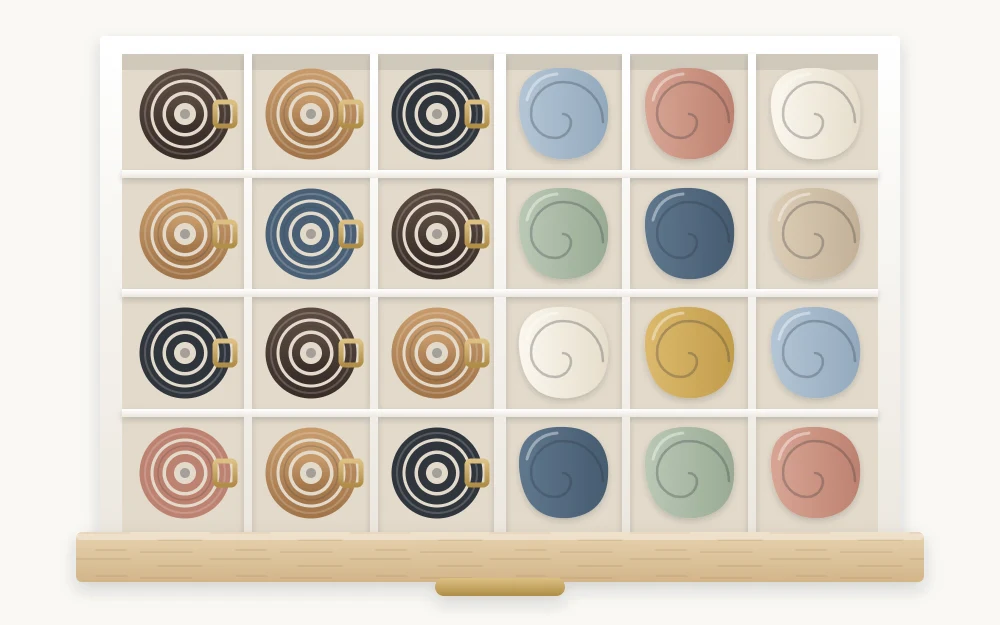
Rolling suits most belts and needs no wall or rod space. Start at the buckle end, roll the belt loosely around the buckle, and stand the roll on its side in a compartment so the buckle faces up.
The rolls need walls around them, or they unroll. A drawer divided into small sections, or a shallow box with a grid insert on a shelf, keeps each one in shape. The guide to setting up an accessory drawer with dividers walks through measuring and dividing a drawer for exactly this. Roll loosely, and if a belt is stiff or shows a crease when rolled, hang that one instead.
Scarves: three methods compared
Scarves vary far more than belts, from thin squares to thick winter lengths, so one method rarely suits a whole collection.
| Method | Suits | Space used |
|---|---|---|
| Folded and filed on edge in a shallow drawer or bin | Most scarves, especially medium and thick ones | Drawer or shelf space; very little per scarf |
| Looped through a multi-ring scarf hanger or over a padded hanger bar | Thin and medium scarves you want to see at a glance | Rod width and the hanging height below it |
| Rolled in a divided box | Small and thin scarves that hold a roll | A shelf or drawer; one compartment each |
Folding and filing. Fold the scarf into a rectangle a little shorter than the drawer or bin is deep, then stand it on its folded edge beside the next one. This is file folding: items stand in a row like files instead of lying in a stack, so you see every one from above and can lift one out without disturbing the rest.
Hanging. A multi-ring scarf hanger holds one scarf per ring. A padded hanger with a horizontal bar holds several scarves draped side by side. Both keep scarves visible, though a full hanger becomes bulky. The guide to choosing closet hangers covers hanger types and what each is suited to.
Rolling. Fold the scarf lengthwise into a strip, roll it loosely and set the roll in a compartment. It works for small scarves that keep their shape and less well for slippery fabrics, which unroll.
Thick scarves and delicate scarves
Thick winter scarves are bulky and forgiving. Fold or roll them and keep them together in an open bin on a shelf, where they can be pulled out as a group.
Thin, delicate scarves need the opposite treatment. Fold them flat with as few folds as possible, or drape them over a smooth, padded bar. Keep them away from rough surfaces, exposed hook tips, zippers and buckles, all of which can snag fine fabric.
Tip
Run your hand over any hook, ring or bar before trusting a fine scarf to it. If it catches your skin, it will catch the fabric.
Where to keep them
Belts and scarves are picked up while you dress, so keep them near where you dress, at a height between your waist and your eyes if space allows. A hook row beside the rod or the top drawer of a unit in the closet are both good spots.
Sort by season or by frequency of use, whichever matches how you reach for them. Winter scarves can move to the upper shelf in a bin when the weather warms, as long as they are clean and completely dry first; follow each care label for cleaning. Belts used all year stay where they are.
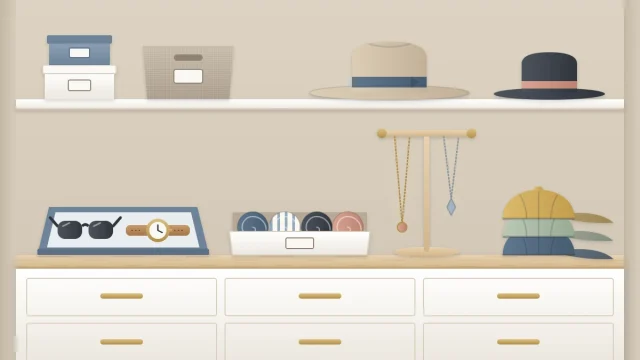
If you are organizing other small items at the same time, the guide on how to organize accessories in a closet covers hats, gloves, ties and jewelry.
A note on hooks and rails
Good to know
Hooks and rails differ in how they attach and in what they are designed to carry. For any hook or rail on a wall or door, follow the product manufacturer’s instructions for fitting it, and use it only for what those instructions say it is meant to hold. Ask the manufacturer or a qualified installer when unsure.
Keeping the system going
A system for small items lasts only if putting one back is as quick as dropping it. Check yours after two weeks. If belts are draped over the rod again, the hooks may be too far away or too crowded. If scarves have turned back into a pile, the bin may be too deep or too full.
Adjust the location or reduce the number, and count again at each change of season.
Frequently asked questions
Is it better to hang belts or roll them?
Both work. Hanging by the buckle keeps belts visible and uses wall, door or rod space. Rolling uses a divided drawer or box and suits most belts. If a belt is stiff or creases when rolled, hang it. Choose by how many belts you counted and which space is free.
How do I store scarves so they do not wrinkle?
Use as few folds as possible. Fold thin scarves flat and file them on edge, or drape them over a smooth padded bar. Avoid cramming too many into one bin, since pressure sets creases. Some creasing is normal for folded fabric; follow the care label if a scarf needs pressing.
Can belts and scarves share one drawer?
Yes, if the drawer is divided so each roll or fold has its own compartment. Keep buckles away from delicate scarves, which snag easily, by giving fine fabrics a separate section or a separate container. A shallow drawer works better than a deep one because everything stays in a single visible layer.