What to Hang and What to Fold in Your Closet
Which clothes belong on hangers and which on shelves or in drawers, decided by how the fabric behaves, how the garment is built and how much rod and shelf space your closet has.
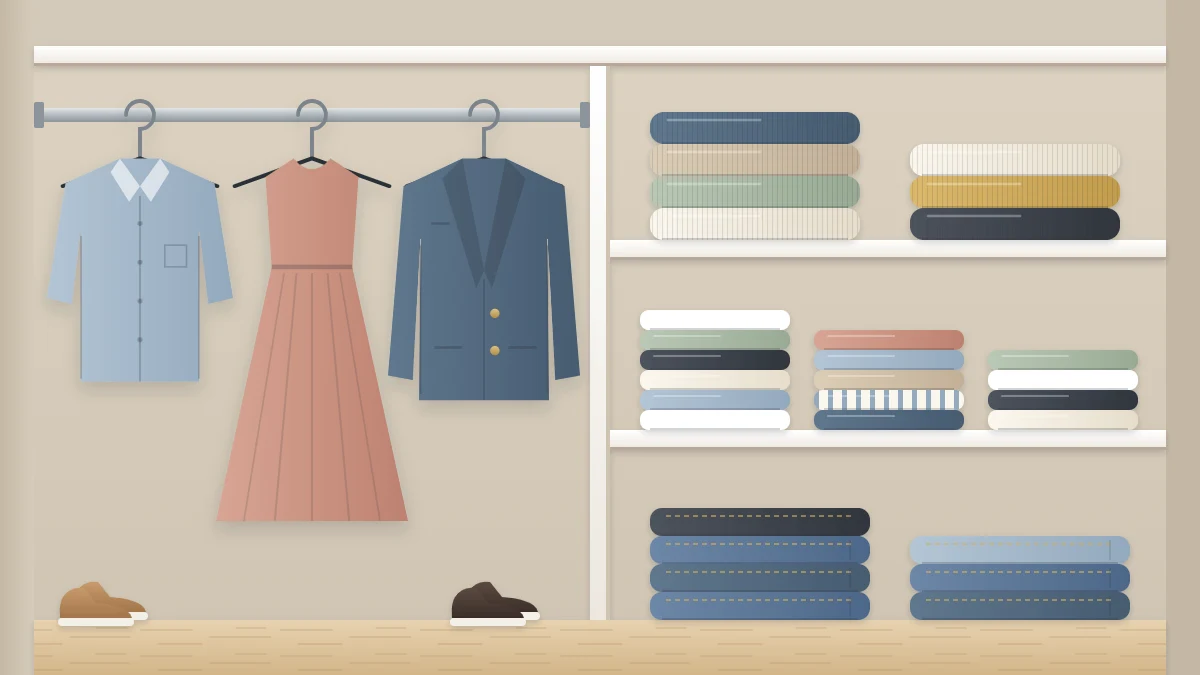
Some clothes keep their shape on a hanger and lose it on a shelf. Others do the opposite. Working out what to hang and what to fold is less about rules than about three things: how the fabric behaves, how the garment is built, and how much rod and shelf space your closet really has.
This is a storage question, not a style one. The aim is that each garment comes out of the closet in the condition it went in, and that the closet’s space is used for the things that need it.
Three things that decide it
How the fabric behaves
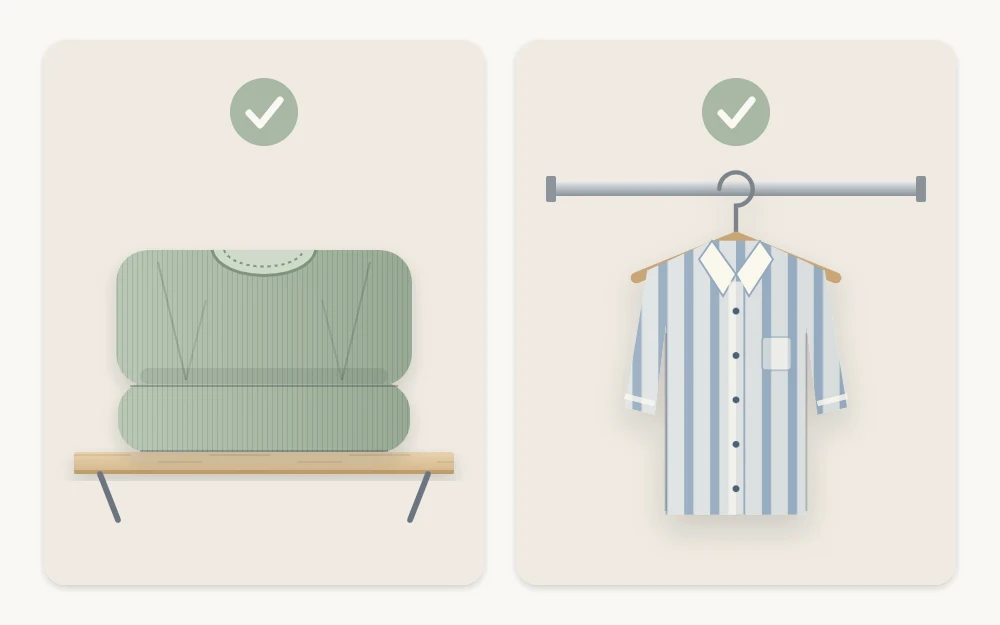
Knitted fabrics are made of loops, and loops give. A knit left on a hanger carries its own weight from the shoulders, and over time it can stretch out of shape or develop bumps where the hanger ends sit. Folded on a shelf, the same knit is supported along its whole length.
Crisp woven fabrics behave differently. They hold their shape on a hanger but take a crease wherever they are folded, so a folded woven shirt usually needs pressing before it is worn.
How the garment is built
A garment with tailored shoulders, a lining or a collar that should stand is built around a shape. A hanger keeps that shape; a fold flattens it. Soft, unstructured garments have no shape to protect and are happy either way.
The space you have
A closet with a long rod and one shelf pushes you toward hanging. A closet with a short rod and plenty of shelves or drawers pushes you toward folding. Neither is wrong. The ideal answer for a garment sometimes has to give way to what the closet can hold.
A quick reference table
The table gives typical answers. Treat them as a starting point and check any garment you are unsure of against its care label.
| Usually hang | Usually fold | Either way |
|---|---|---|
| Shirts and blouses | Heavy sweaters and knitwear | Casual pants |
| Dresses | T-shirts | Light cardigans |
| Jackets and coats | Jeans | Sweatshirts |
| Dress pants | Exercise clothes | Shorts |
| Skirts | Sleepwear | Casual knit dresses, by fabric |
What usually hangs
Hang the garments that crease easily or have a shape worth keeping:
- Shirts and blouses. Woven fabric creases at every fold, and collars sit better on a hanger.
- Dresses. Most are too long to fold without several creases. Very stretchy or heavy knit dresses are the exception.
- Jackets and coats. The shoulders are shaped and need support across their width.
- Dress pants. Hung by the cuff or hem from a clip hanger, or folded once over a bar, they keep their crease.
- Skirts. Hung from the waistband so the fabric falls straight.
Long garments such as dresses and coats need long-hang space, meaning a section of rod with a clear drop below it so hems do not rest on the floor or on bins. The hanger matters as much as the decision to hang, and the guide on choosing closet hangers explains which type suits which garment.
What usually folds
Fold the garments that stretch on a hanger or that are sturdy enough not to mind a crease:
- Heavy sweaters and knitwear. These are the clearest case for folding, for the stretching reason above.
- T-shirts. They are knits too, and they stack compactly.
- Jeans. Denim is sturdy and folds flat without harm.
- Exercise clothes. Stretchy and often slippery, so they stay put better folded or in a bin than on a hanger.
- Sleepwear. Soft and unstructured, with nothing to protect.
How to keep those stacks neat is a subject of its own, covered in the guide to organizing folded clothes on shelves.
Items that depend on the garment
Delicate and slippery pieces do not fit neatly into either list. A fine knit may stretch on a hanger yet crease or snag in a stack. A slippery fabric may slide off an ordinary hanger yet crumple when folded. Beaded, embellished or very loosely woven pieces can pull under their own weight.
For anything unusual, the care label is the best guide. Some labels say plainly to store the garment flat or not to hang it. Where the label is silent, look at the garment after a few weeks in its spot: shoulder bumps, a lengthened hem or a stretched neckline mean it should be folded, and set creases mean it would be better hung.
Good to know
These lists describe how common fabrics tend to behave, not a rule for every garment. Fabric blends vary, so let the care label and the garment’s own condition have the last word.
When hanging space is short
If the rod is full and garments cannot slide, move the sturdy items off it first. Work down this order until the rod has slack again:
- T-shirts, sweatshirts and exercise clothes that ended up on hangers.
- Jeans and casual pants.
- Light cardigans and casual knit dresses.
Keep the rod for what truly needs it: shirts, jackets, coats, dress pants and most dresses. Once the rod holds only those, the guide on how to organize hanging clothes shows how to arrange them.
When shelf space is short
The opposite problem has the opposite answer: hang more. Items from the “either way” column go on the rod first, followed by jeans and casual pants folded over a bar hanger. T-shirts can hang too, if they are light and the hanger is the right width for their shoulders.
Heavy knitwear is the last thing to move to the rod. If it truly has nowhere else to go, fold it over the bar of a hanger instead of hanging it by the shoulders, so the weight is not pulling on the neckline.
Whichever way you lean, decide by category. If all sweaters are folded and all shirts are hung, you always know where to look and where to put things back.
Frequently asked questions
Should sweaters be hung or folded?
Heavy sweaters and most knitwear are usually better folded. A knit on a hanger carries its own weight from the shoulders and can stretch or form bumps over time. If shelf space is very short, fold the sweater over the bar of a hanger instead of hanging it by the shoulders.
Is it better to hang or fold T-shirts?
Folding is the usual choice, because T-shirts are knits and stack compactly. Hanging works too when shelf space is short, provided the shirt is light and the hanger matches the width of its shoulders. Pick one way for the whole category so you always know where to look.
Should jeans be hung or folded?
Jeans are sturdy and fold flat without harm, so they usually go on a shelf or in a drawer and leave rod space for garments that crease. If you have more rod than shelf, folding them once over a bar hanger works just as well.