Common Closet Organization Mistakes and How to Fix Them
Eleven common reasons an organized closet does not stay that way, from buying bins too early to skipping labels and routines, each with a plain explanation and a fix you can apply one at a time.
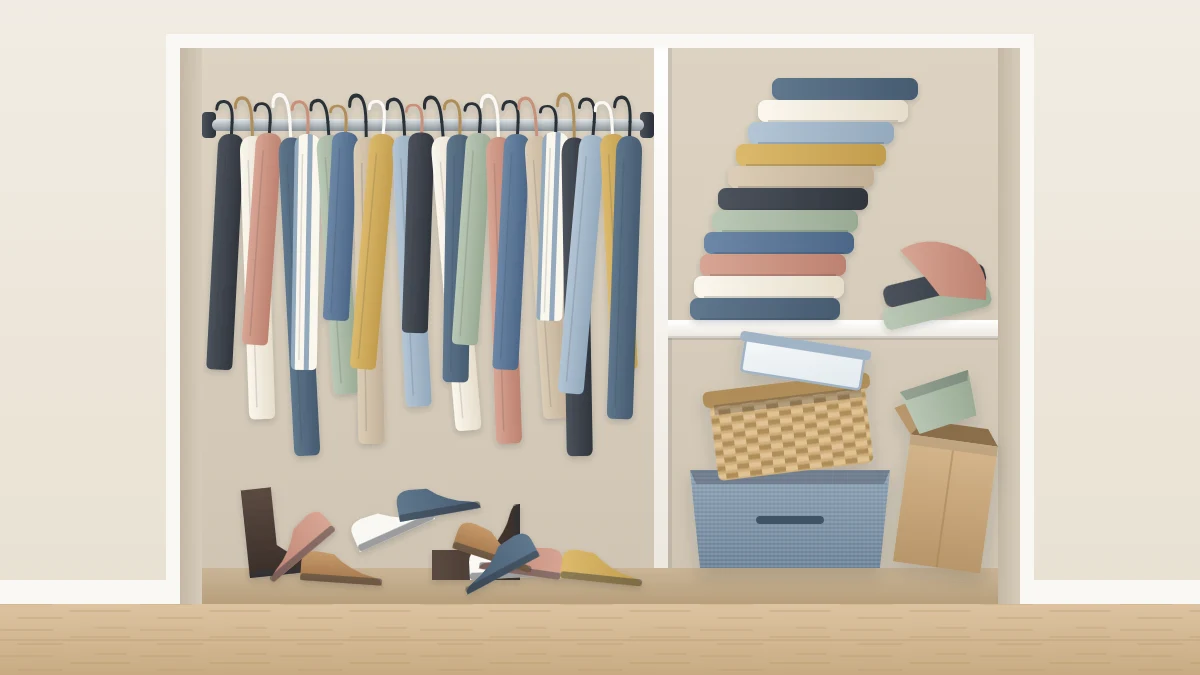
If you have organized your closet more than once and it has not lasted, the cause is rarely laziness. It is usually one of a small number of closet organization mistakes that almost everyone makes, because each one feels like the sensible thing to do at the time.
Below are eleven of them, grouped by where they happen, each with the reason it causes trouble and the fix. You will probably recognize two or three. They are normal, and they can be fixed one at a time.
Mistakes made before you start
1. Buying bins and organizers first
Shopping feels like progress, but containers bought before you know what they will hold, or how wide the shelf is, seldom fit either. Fix: declutter, then measure, then buy. The guide on how to measure a closet and plan the layout shows what to write down before you spend anything.
2. Organizing without reducing
Rearranging everything you own puts the same volume into the same space in a neater pattern. It looks better for a week. Fix: take out what you no longer use before deciding where anything goes. Less to store is the only change that creates room.
3. Keeping every season in the closet at once
Heavy coats in July and shorts in January take up the easiest space to reach while doing nothing. Fix: move off-season clothes to the upper shelf, under the bed or another closet, and swap them when the weather turns. In a mild climate, shifting them to the less convenient end of the rod may be enough.
Layout mistakes
4. No defined zones
When no area belongs to a category, things go into the nearest gap, and next week you search three places for one shirt. Fix: give every category one home and keep it there. The guide to closet zones explains how to divide the space.
5. Daily items stored high or deep, rare items at hand height
The space between your shoulders and your knees, at the front of the closet, is the easiest to use. If occasion clothes fill it while everyday T-shirts sit on the upper shelf, each morning involves reaching and digging. Fix: rank categories by how often you use them and give the most-used ones the easiest space. Deep shelves need their own approach, described in the guide on how to organize a deep closet.
Shelf and rod mistakes
6. Stacks too tall and bins too deep to search
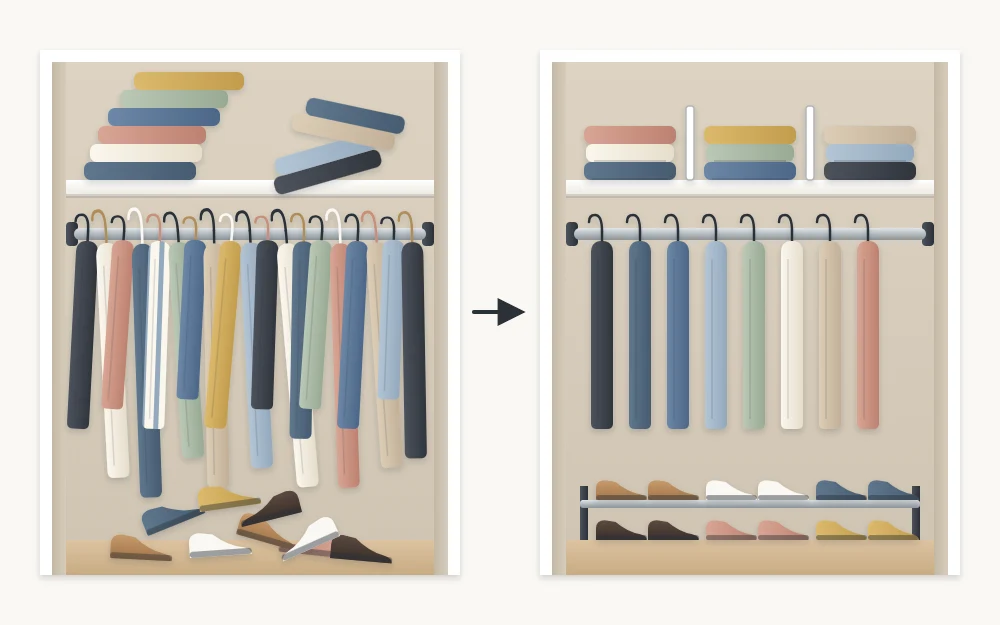
A tall stack leans, and pulling one item from the middle brings the rest down. A deep bin hides everything under its top layer, so the bottom half is forgotten. Fix: keep stacks low enough to lift with two hands, add shelf dividers between them, and choose shallower bins or stand items on edge inside them so each one is visible from above.
7. Mixed hangers and an overpacked rod
Hangers of different shapes and thicknesses hold garments at different heights and waste rod space. A rod with no slack makes it hard to remove one item or return it, so clothes end up draped elsewhere. Fix: use one type of hanger per section, and reduce or relocate garments until you can slide the hangers along the rod with ease.
Mistakes with overlooked space
8. Ignoring the door, the floor and the upper shelf, or cramming them
These three areas go wrong in two opposite ways. Some closets leave them empty while the rod is jammed. Others pile them with loose items: a heap of shoes on the floor, a slope of sweaters overhead. Fix: use them on purpose and with containers. That means a low rack for shoes under short-hanging clothes, matching bins on the upper shelf, and, if the door allows it, an over-the-door pocket organizer for small accessories.
A hardware mistake
9. Loading or fixing hardware without checking
Every shelf, rod and door organizer has limits, and they are not visible. Filling a shelf to the ceiling, hanging a full row of coats on an add-on rod, or loading a door organizer until the door drags are all done without thinking about what the product was designed for. The same applies to fixing anything to a wall: the right method depends on the product and on what the wall is made of.
Good to know
Fix: look up the stated limits in the product’s specifications before you load it, and follow the manufacturer’s installation instructions for anything attached to a wall or door, using the hardware and method they give. Ask the manufacturer or a qualified installer when unsure.
Mistakes that undo the work later
10. No labels on opaque bins
A row of matching bins looks calm and tells you nothing. Within a month nobody remembers which one holds the scarves, things go back into the wrong bin, and the categories dissolve. Fix: put a short, plain label on the front of each opaque container on the day you fill it.
11. No routine and no outgoing bag
Organizing is an event; staying organized is a habit. Without a moment each week to return strays, and without a place for clothes that are leaving, the closet slowly refills. Fix: keep a donate bag in the closet, and spend a few minutes straightening up when you put laundry away.
Fix one mistake at a time
You do not need to empty the closet and begin again. Pick the mistake that costs you the most time each morning and fix only that. Then live with the change for a week or two before choosing the next.
A rough order that works for many closets is: reduce, set zones, correct what sits at hand height, then deal with containers and labels. Buying comes last. If you would prefer to work through the whole process in sequence, the guide to closet organization for beginners lays out the steps from the start.
Frequently asked questions
What is the most common closet organization mistake?
Buying bins and organizers before decluttering and measuring is among the most frequent. Containers chosen without knowing what they will hold or how wide the shelf is rarely fit either. Reduce what you own first, measure the space, and buy last, for one shelf at a time.
Why does my closet not stay organized?
Common causes are categories without a fixed zone, everyday items stored where they are hard to reach, a rod with no slack, and no weekly habit of returning strays. Find the one that costs you the most time each morning and fix that first.
Do I have to empty the whole closet to fix these mistakes?
No. Most of these problems can be corrected one at a time without starting over. Choose a single issue, such as stacks that are too tall or a missing donate bag, change it, and live with the result for a week or two before moving on.