What Clothes to Keep: Questions for Hard Decluttering Decisions
A decision aid for the maybe pile. Find the reason an item is hard to let go, whether cost, a gift, fit, a rare occasion, a memory or a spare, and use the matching question, limit, date or count.
The first pass through a closet is the easy part. The worn-out and the outgrown leave quickly, and what remains is the maybe pile: the things you do not use and cannot quite release. Deciding what clothes to keep from that pile is slow because each item is hard for a different reason.
That is the useful part. Once you can name the reason, the right question tends to follow. This guide sorts the difficult items by why they are difficult and offers a question and a practical way forward for each. If you have not done the main sort yet, start with the guide on how to declutter a closet and come back with your maybe pile.
Three questions that work on almost anything
Before looking at reasons, try these on each item. They are about how you use the thing, not about how it looks.
- Would you pick it today? If it were not already yours and you saw it now, would you choose to bring it home?
- Do you reach past it? When you get dressed, does your hand go to it, or move around it to get to something else?
- Does it need a repair you will really do? A missing button is a few minutes of work. Be honest about whether those minutes will happen, and set a date if they will.
Items that pass go back in the closet. Items that fail clearly can go. The ones still in your hands usually belong to one of the groups below.
It was expensive, or it was a gift
The cost
The money was spent on the day you bought it, and keeping the item does not bring it back. The honest question is: does it do anything for me now, apart from reminding me what it cost?
If the answer is no, the item is using closet space to hold a regret. Passing it on to someone who will use it, or selling it if it is worth the effort, is a better end for it than another year on the hanger.
The giver
A gift has done its job once it has been given and received. Ask: would the person who gave it want it sitting unused out of obligation? Almost always, no.
You can keep the gratitude and release the object. If that still feels wrong, keep it. One sweater kept out of affection for the giver is not a storage problem.
It might fit again
Bodies change, and keeping some clothes in another size is reasonable. The trouble starts when they hang among the things that fit and make every morning slower.
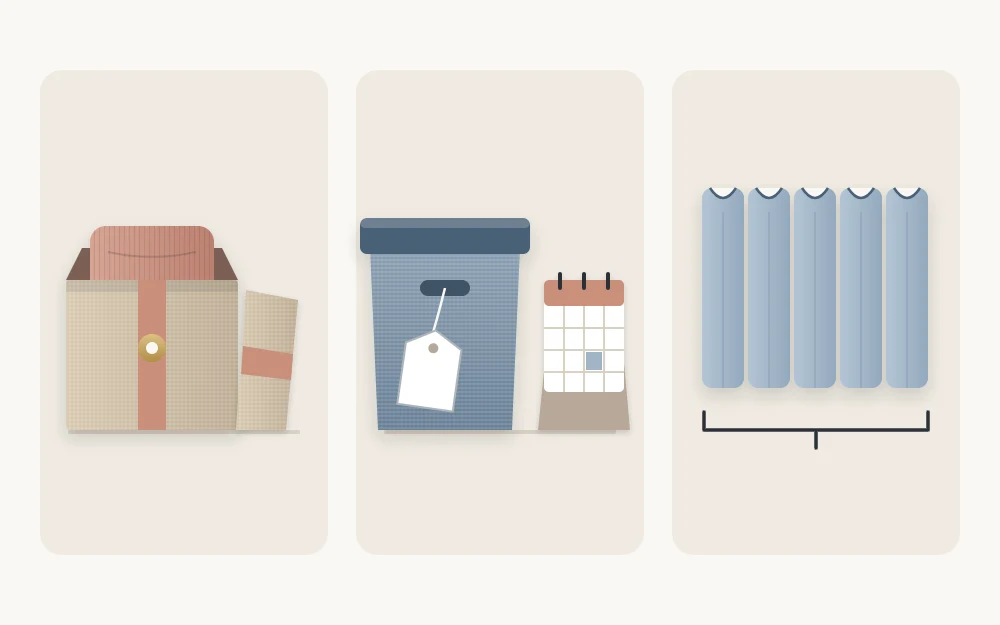
Move them out of the working closet. Choose the pieces you would truly be glad to wear again, put them in one box, and write a review date on it. When that date comes, open the box and decide again with the same three questions.
It is for a rare occasion
Formal clothes, interview clothes, a heavy coat for one cold trip a year: low use is normal for these, so “when did I last wear it” is the wrong test. Ask instead: is the occasion real and likely, and would I choose this item for it?
If yes, keep it, and store it away from the daily zone, in a garment bag at the far end of the rod or on an upper shelf. If the occasion belongs to a job or a period that is over, it can go.
It holds a memory
A team shirt, a concert T-shirt, the dress from an important day. These are keepsakes that happen to be made of fabric, and they should be judged as keepsakes.
The practical tool is a limit. Choose one small box for clothing keepsakes, and let the box decide how many you keep. When it is full, adding one means choosing one to take out. This keeps the memories you value most and spares the rod.
It is a spare, or it still has the tags on
Spares are sensible up to a point, and the point can be counted. Ask: how many of these do I need between laundry days? If you wash weekly and wear one a day, you need about a week’s worth plus a couple extra, not twenty. Count what you have, keep the ones in the best condition, and let the rest go.
Unworn items with tags attached combine two reasons: cost and hope. Use the first of the three opening questions. If you would not choose it today, a tag does not change the answer, and an unworn item is among the easiest to pass on.
Let the space make the decision
When questions do not settle it, storage can. Every category has a home of a fixed size: a length of rod, one shelf, one drawer. That space decides how many items the category holds comfortably, with room to slide a hanger or lift a stack.
If your sweaters have one shelf and fifteen fit without cramming, the number is fifteen. Choosing your fifteen is far easier than judging each one alone, because you are picking what you like most, not hunting for faults. The number comes from your closet, so it will differ from anyone else’s.
Tip
Still undecided about a few pieces? Put them in a box, write a date a few months ahead on it, and store it out of the way. Anything you did not go looking for by that date is easier to release.
You are allowed to keep things
The aim is a closet you can use: you can see what you own, reach it and put it back. It is not to reach a minimum count, and no number of items is correct for everyone. If something earns its space because you love it, keep it without apology.
For everything that is leaving, the guide on what to do with clothes you no longer wear covers the routes out. And a short, regular review as part of a closet maintenance routine keeps the maybe pile from building up again.
Frequently asked questions
How do I decide what clothes to keep and what to let go?
Ask three things about each item: would you pick it if you saw it today, do you reach past it when dressing, and does it need a repair you will really do? For items that still feel hard, name the reason, such as cost or sentiment, and use a limit, a date or a count.
Should I keep clothes that might fit again?
Keeping some is reasonable, but move them out of the working closet. Choose the pieces you would truly be glad to wear, put them in one box and write a review date on it. When the date arrives, open the box and decide again, rather than facing them every morning.
How many clothes should I own?
There is no number that is right for everyone. A practical guide is your own storage: the rod length, shelf or drawer a category has decides how many items fit comfortably. For spares, count how many you need between laundry days and add a couple.