How to Store Boots in a Closet
Tall boots slump, crease and spread across the closet floor. Here is how to prepare them, keep the shafts upright, and choose between standing, hanging and flat storage.
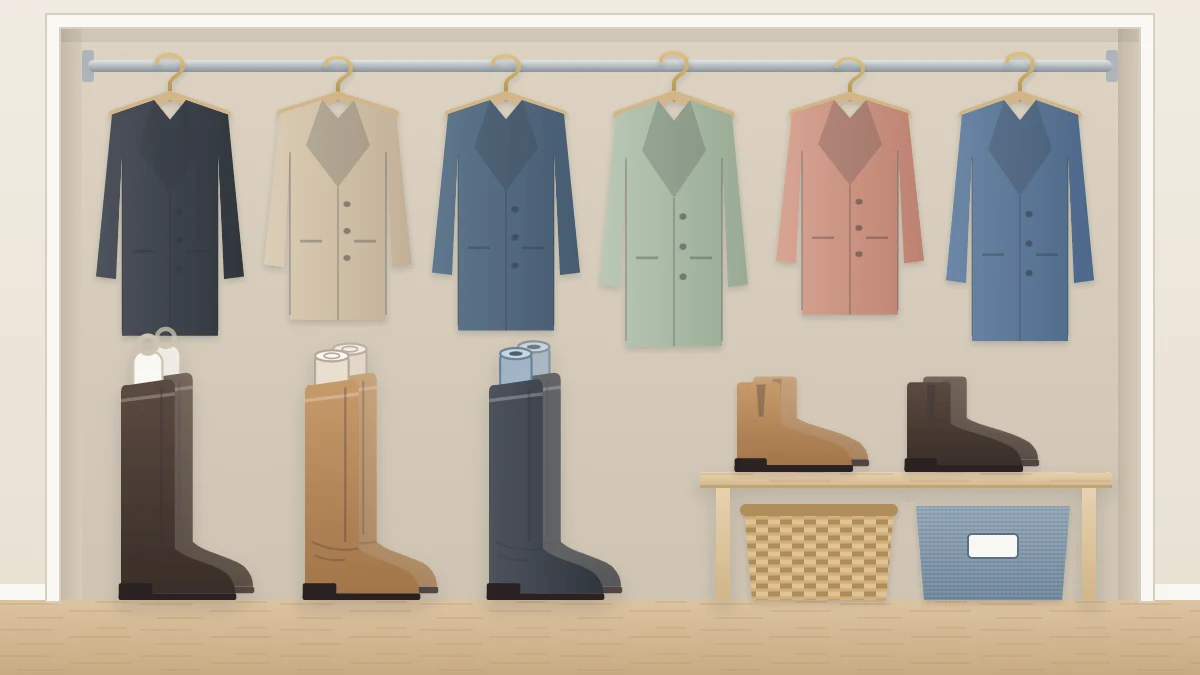
Tall boots are the awkward item on any closet floor. Left to themselves, the shafts slump sideways, one pair leans on the next, and a row of four takes the room of eight. Learning how to store boots is mostly a matter of two things: keeping the shaft upright and giving the pair enough height.
Neither needs special equipment. What you need is a clear idea of how many pairs you own, how tall they are, and which of three storage positions your closet has room for.
Why boots need different handling from shoes
A shoe holds its own shape. A tall boot does not: the shaft is a soft tube, and when it folds over, it tends to crease along the fold. The longer it stays folded, the more settled that crease can become, particularly in leather and similar materials.
Boots also need more height than a shoe shelf usually gives. Measure your tallest pair from the floor to the top of the shaft, standing straight, and compare that figure with the space you have in mind. A shelf spaced for sneakers will not take them upright.
Ankle boots are the exception. They stand on their own and fit on a regular shelf, as long as the gap above the shelf is a little taller than it would be for flat shoes.
Before boots go into the closet
Boots come in from wet streets and muddy paths, so a short routine keeps the closet clean and the boots in better condition.
- Let them dry fully at room temperature, away from direct heat such as a radiator or heater.
- Brush or wipe off loose dirt once they are dry.
- Follow the maker’s care guidance for the material. Leather, suede, rubber and fabric are each looked after differently, and the care label or the maker’s instructions are the place to check.
Only then put them away. Storing boots while they are still damp, especially in a closed box, is the one thing to avoid.
Keeping the shaft upright
Something inside the shaft does the work. You have two choices.
- Boot shapers. These are purpose-made inserts, sold in pairs, that slide into the shaft and hold it straight. Check the height against your boots before buying, since shafts vary.
- A homemade insert. Rolled paper works: roll several sheets into a loose tube, slip it in, and let it spring open against the sides. A length of foam tube cut to the height of the shaft does the same job and lasts longer.
Whichever you use, the insert should fill the shaft gently. If you have to force it in, it is too wide, and it may stretch the shaft or strain a zipper.
Tip
Cut homemade inserts slightly shorter than the shaft so nothing sticks out of the top, and make one for each boot rather than sharing them between pairs.
Three storage positions compared
With the shaft supported, a tall boot can be stored standing, hanging or lying flat. Each uses a different part of the closet.
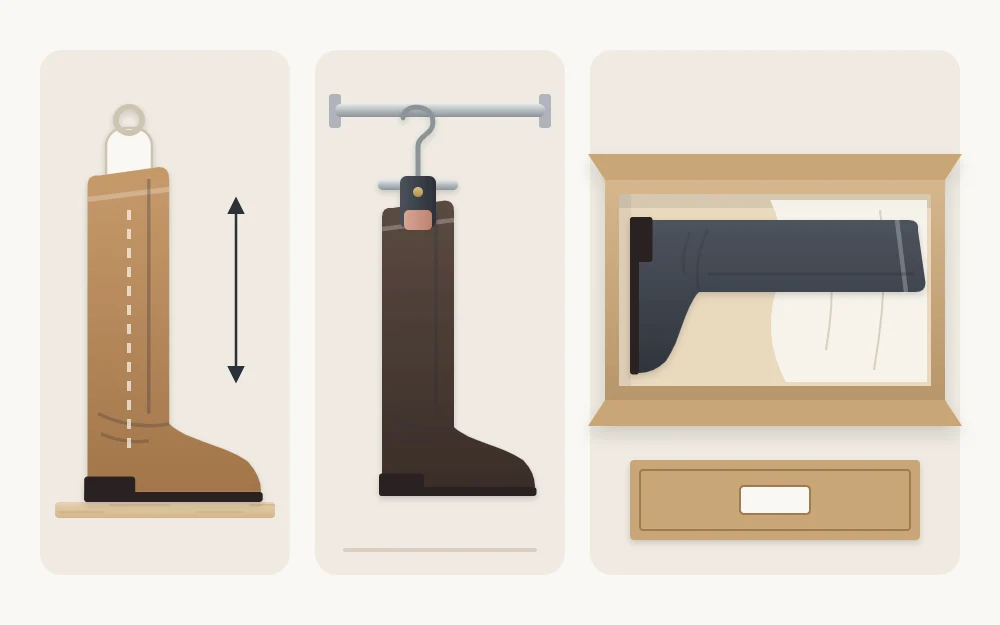
| Position | Space used | Suits |
|---|---|---|
| Standing upright with inserts | Floor or a tall shelf, the full height of the boot | Pairs worn often in season |
| Hanging from boot clips | Rod width and the height below the rod | Closets with spare rod space and a crowded floor |
| Lying flat in a long box | A deep shelf, or the space under a bed | Off-season pairs and pairs worn rarely |
Standing upright
This is the easiest position to live with. Stand each pair side by side with inserts in place, toes pointing out, on the floor or on a shelf tall enough for the shaft. The floor under long-hang clothes (coats, dresses and other full-length garments) is often wasted space and a natural home for a row of boots, provided the hems clear the tops.
Hanging from clips
Boot clip hangers grip the top edge of each shaft and hang from the rod, so the boots hang by their shafts and the floor stays free. Look for padded clips, place them at the top edge rather than partway down the shaft, and check the product’s instructions for how to attach them and which boots they are meant for. Clips can leave a mark on soft materials, so test on one pair for a few days first. Remember that hanging boots add to what the rod is carrying, so stay within the limits stated by the rod’s manufacturer.
Lying flat
A long box or an under-bed container holds boots on their sides. Keep the inserts in, lay the pair heel to toe, and put a sheet of paper between pairs so buckles and zippers do not rub against the next boot. This position hides the boots, so it suits pairs you will not want for a while.
Where ankle boots go
Ankle boots need no inserts and no special position. Treat them as tall shoes: a shelf, a rack tier or a cubby with enough height. If your current shoe storage is too short for them, the comparison of shoe storage ideas shows which options can be adjusted. For where they sit among the rest of your pairs, see the guide on how to organize shoes in a closet.
Storing boots for the off-season
When the season ends, the same rules apply with a little more care, because the boots will sit untouched for months.
- Clean them and let them dry completely.
- Put the inserts in.
- Use a breathable box or a fabric bag rather than sealing them in plastic while there is any moisture left.
- Store them somewhere dry, away from direct heat and strong sunlight.
The guide to seasonal clothing storage covers where off-season items can go and how to pack them.
What good storage can and cannot do
Supporting the shaft reduces slumping, and that reduces the folds that set into creases. It does not make boots immune to wear. Materials crease at the ankle from walking, and no storage method changes that.
What it does change is the closet. Upright boots take a fixed amount of floor, and each pair is visible. Count your pairs, measure the tallest, pick the position your closet has room for, and adjust after a few weeks of use.
Frequently asked questions
What can I use instead of boot shapers?
Rolled paper or a length of foam tube cut to the height of the shaft both work as homemade inserts. The insert should fill the shaft gently without stretching it. Make one for each boot so they stay with the pair, and check that nothing presses hard against a zipper.
Is it better to hang boots or stand them up?
It depends on which space you have. Standing boots use the floor or a tall shelf and are quickest to put back. Hanging them from padded clips frees the floor but uses rod space and adds load to the rod. Follow the clip product's instructions and test on one pair first.
Can I store boots in a plastic box?
A box is fine for boots that are clean and completely dry. Avoid sealing them in while any moisture remains; a breathable box or a fabric bag is the more forgiving choice for long storage. Keep inserts in the shafts and put paper between pairs so hardware does not rub.