How to Organize Shoes in a Closet
A method for the pile on the closet floor: gather and edit every pair, sort by how often each is worn and then by type, place each group at the right height, and count pairs per row before buying a rack.
A pile of shoes on the closet floor is rarely a storage problem at first. It is a sorting problem: every pair has been given the same spot, whether it is worn daily or once a year, so the pile grows and the pair you want is always underneath.
To organize shoes in a closet, work through a method before thinking about racks: gather every pair, edit, sort by how often each is worn, then by type, and only then decide where each group lives.
Gather every pair and edit
Bring all your shoes to one place, including the ones by the front door, under the bed and in the hall. Line them up in pairs on the floor so you can see the whole collection at once.
Then edit. Set aside pairs that no longer fit, that are worn past use, or that you have stopped reaching for. Put single shoes with no partner in the same group. Outgoing pairs go into a bag and out of the room, so you are organizing only what stays.
Count the pairs that remain and write the number down. You will need it later.
Sort by how often you wear them
Divide the keepers into three groups. Be honest about the recent past, not about intentions.
- Daily pairs. The two or three you wear most days.
- Regular pairs. Worn weekly or a few times a month.
- Occasional and off-season pairs. Worn a few times a year, or only in one season.
This sort decides how good a spot each pair deserves. It is the same idea that governs the rest of the closet, explained in the guide to closet zones: the more often something is used, the easier it should be to reach.
Give each group its place
Daily pairs
These get the easiest spot of all, and that spot is often not in the bedroom closet. If you put shoes on and take them off by the front door, a small rack or tray there may serve daily pairs better, and it keeps outdoor dirt out of the closet. If you prefer them in the closet, give them the front of the lowest shelf or rack, where they can be stepped into and out of.
Regular pairs
These belong inside the closet at a height you can reach without a stool or a deep crouch: a low rack, a shelf between knee and shoulder height, or a row along the front of the floor.
Occasional and off-season pairs
These can go higher or farther back, usually in boxes. The upper shelf suits them well. Reach it with a stable step stool used as its instructions describe, never a chair.
Then sort by type
Inside each group, put similar shoes together: sneakers with sneakers, flats with flats, heeled shoes together, ankle boots together. This makes a pair easier to find, and it has a second benefit.
Shoes of one type are about the same height. A row of flats needs very little clearance, while a row of ankle boots needs much more. When similar heights sit together, shelf spacing can be set to suit each row and little vertical space is wasted. Measure the tallest shoe in each type before deciding which shelf it goes on.
Tall boots are a case of their own, since they need height and support to keep their shape. The guide on how to store boots deals with them.
Placement tips that make the space work
- Keep shoes off the floor. A low rack or shelf lifts them enough for the floor underneath to be vacuumed, and it defines where the shoe zone ends.
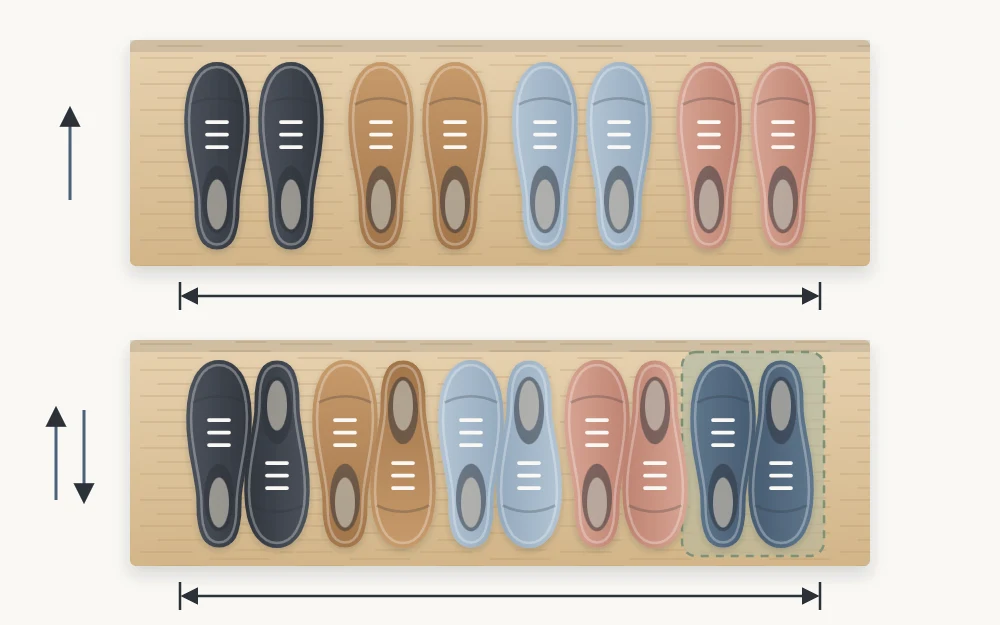
- Alternate toe-to-heel. Shoes are wider at the toe than at the heel. Turning one shoe of each pair around lets the pairs nest closer, which can fit an extra pair in a row.
- Keep pairs together. A pair split between two shelves is a pair you will not find.
- Let shoes dry and air first. Shoes that are damp from wear or weather should dry in the open before they go into a box or a closed closet.
Tip
Toe-to-heel suits pairs you wear now and then. For daily pairs, keeping both shoes pointing the same way is quicker to step into and worth the small loss of space.
Use the space under short garments
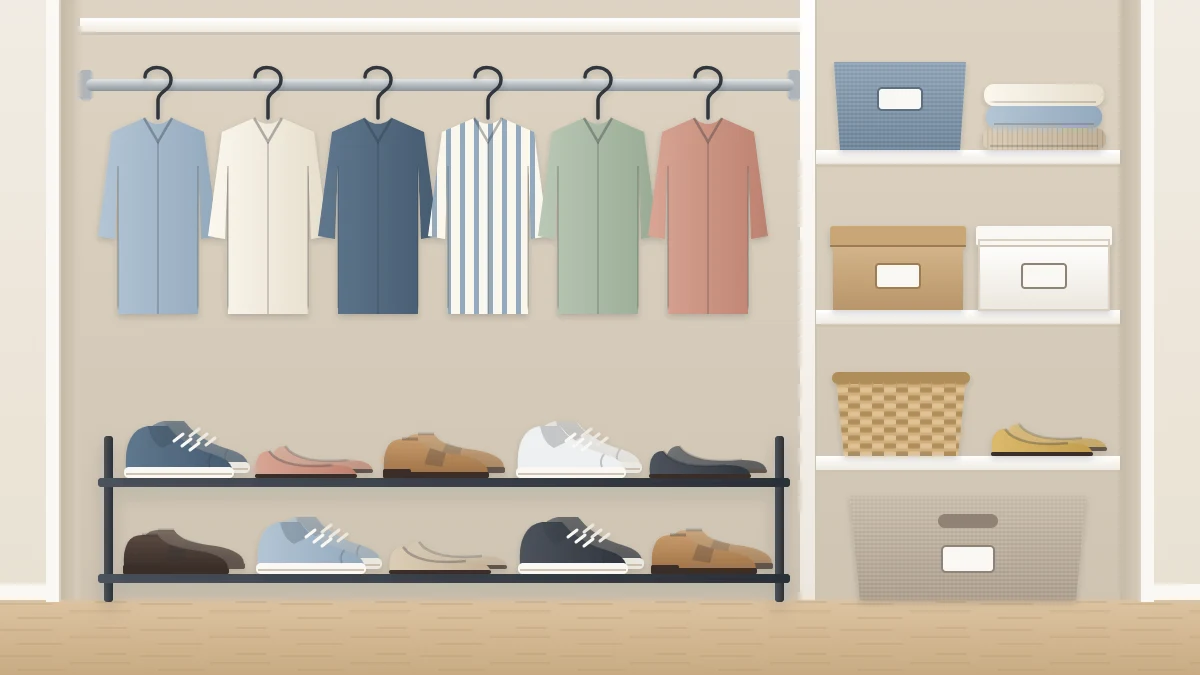
The area below shirts, jackets and folded pants on the rod is often empty, and it is at a convenient height for shoes. Measure from the floor to the lowest hem in that section, then the width of the section, and you know the size of rack or shelf unit the space can take.
Boxes for pairs stored out of sight
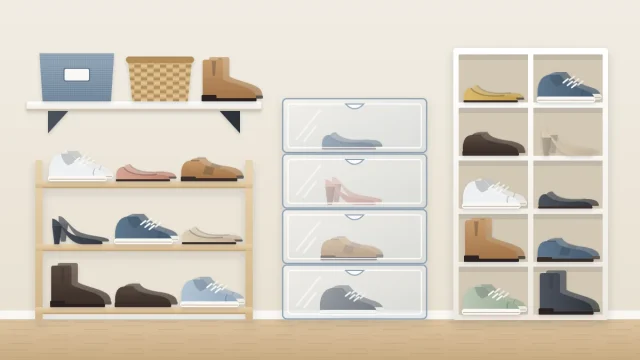
Occasional and off-season pairs keep cleaner in boxes, and boxes stack where loose shoes cannot. The drawback is that a closed box hides what is in it. Two simple answers:
- Clear boxes, so the pair shows through the side.
- Boxes with a label area, where you write a few words describing the pair.
Make sure shoes are clean and completely dry before boxing them, and keep stacks low enough that the bottom box can be reached without unloading the rest.
Count pairs per row before buying a rack
Now use the number you wrote down. For each place you plan to keep shoes, work out how many pairs fit in one row: line pairs up on the floor against a tape measure set to the width of the space. Multiply by the number of rows the height allows.
If the total is less than your pair count, you know exactly how many pairs need another home or need to go, before any money is spent. If it is more, you may need less storage than you thought.
Good to know
The count depends on your shoes. Pair widths differ a great deal between types and sizes, so measure your own instead of relying on the pair count printed on a rack’s packaging.
With those figures in hand, compare racks, shelves and boxes in the guide to shoe storage ideas and choose what fits both the space and the collection.
Frequently asked questions
Where should everyday shoes be kept?
In the easiest spot you have, which is often near the door of the home instead of in the bedroom closet. A small rack or tray there keeps daily pairs handy and outdoor dirt away from clothes. If they stay in the closet, give them the front of the lowest shelf.
Is it better to store shoes in boxes or on a rack?
It depends on how often the pair is worn. Pairs in regular use are easier on an open rack or shelf, where they can be seen and aired. Occasional and off-season pairs keep cleaner in boxes, ideally clear ones or ones with a label, once they are fully dry.
How do I fit more shoes on a shelf?
Try alternating each pair toe-to-heel, since shoes are wider at the toe and nest closer that way. Group shoes of similar height on one shelf so the spacing above them is not wasted. Then count how many pairs truly fit per row before adding any more.